GOOD SEAMANSHIP IN THE HARBOR IS GOOD FORM

Help each other, give other boats room, and check havneguide.dk before calling the marina
Illustrations: Gert Eilenberger
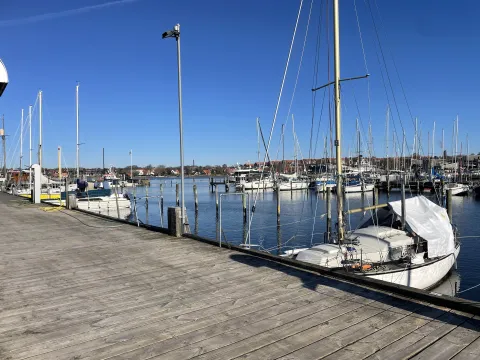
For most people, a great day on the water ends with a stop at one of Denmark’s 350 marinas. Maybe it’s even your first time visiting the marina—and who knows, perhaps many other sailors have chosen this marina as well? Is there space? Where should we moor? How much does an overnight stay cost? What are the marina office’s hours of operation?
There are many questions you’d like answers to before arriving, and most of the answers can be found on the marina’s website or at havneguide.dk.
Christian Ørndrup is the harbor master at the Marstal and Ærøskøbing Harbors. He estimates that up to 80% of the calls he and his colleagues receive on their cell phones during the course of a day are about information that can easily be found online:
– “We spend a lot of time answering questions about information that’s already available on our website or on havneguide.dk,” says Christian Ørndrup. “If I may offer some really good advice to sailors, it’s to check online first. If you can’t find the information there, send a text message or an email. If there are special circumstances regarding your boat, or if you have specific needs, you’re of course always very welcome to contact us.
It can be difficult to predict space availability in a marina, and even the marina manager can’t say how many boats are arriving or on their way to the marina. But just sail right in. Sailors are good at helping each other out, offering mooring lines, or pointing out available berths. It’s good etiquette and good seamanship.
Tips for a Great Harbor Experience

Prepare before arriving at the harbor
Good seamanship starts with good preparation. Secure the fenders and have your mooring lines ready. Divide up tasks for the docking maneuver if there are several of you on board, and explain what needs to be done. Some people handle the fenders and prepare the mooring lines, while others are responsible for keeping the boat clear of the neighboring boat as you dock. Have a spare fender ready, and make sure you only have the ropes you’ll need out. Prepare for what’s going to happen—and what MIGHT happen.
Check the
wind direction
Assess the wind conditions before heading out. The wind’s direction plays a major role in how you can maintain control of your boat when docking. Dock into the wind and away from the lee. If there’s wind, it’s a good idea to moor with the bow facing into the wind; this keeps the boat the most stable.
Slow down
Docking maneuvers are situations where damage can occur to your own boat or others’. Slow down. In most places, the speed limit is 3 knots. This makes it easier to control the boat and change direction if necessary. Calmly survey the harbor for available berths, and it’s better to circle the basin one more time at a leisurely pace until everyone is ready to dock at the chosen berth.
Ask for help if you need it. Sailors are helpful and are happy to take a line or offer advice.
Mooring with care alongside another boat
If you’ve chosen a spot alongside another boat, it’s customary to position your bow toward the stern of the neighboring boat. This way, you’ll pass the neighboring boat’s foredeck when going ashore. It also provides more privacy in the cockpit for both parties. If you find a side-by-side berth at the dock, it’s good etiquette to choose your boat’s position carefully. The distance to the boats ahead and astern should be enough to prevent collisions, but no more than that. Leave room for the next boats and hang fenders on the side of the boat facing the harbor basin so you’re ready for the next visiting sailor who docks. Inflatable boats and similar craft should be stowed under the bow.
Use the stern posts as a guide when mooring at a
post berth
When approaching a post berth, be sure to secure the stern posts first. This makes it easier to slow the boat down so it doesn’t run into the dock. Gradually slacken the lines until you are close enough for someone to jump ashore with a mooring line. The same technique applies when you cast off.
Avoid loose halyards
Make sure to secure all your halyards and loose hinges so they don’t rattle and disturb your sleep.
Call the harbor master only for special requests
During the summer season, it can be difficult for the harbor master to answer all calls. Harbor Master Christian Ørndrup from the Marstal and Ærøskøbing Harbors estimates that up to 80% of the calls he receives are about information that can easily be found on the harbor’s website or at havneguide.dk.
For boats with special needs or very large vessels, it’s a good idea to check availability before arrival. Especially during peak season, it can be very difficult for the harbor master to predict availability, as it can change from hour to hour. As a rule of thumb, there are the most available berths in the morning and the fewest in the evening. This can usually be resolved by having boats moor side-by-side; otherwise, you can anchor off the harbor until you might be able to slip into a vacant berth the next morning. Harbor Master Frederik Bilsted Petersen from Ballen Havn emphasizes:
– Sailing is also about taking things as they come, and we’re happy to help you find a berth when you arrive at the harbor.
Source: “Good Seamanship in the Harbor” by the Association of Recreational Marinas in Denmark (FLID).