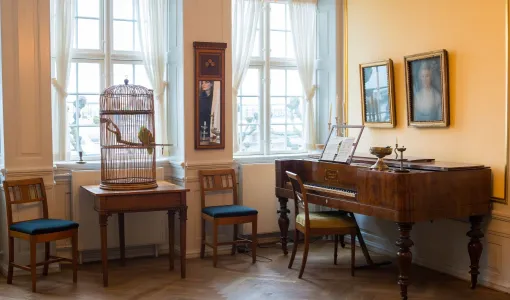



Munkeruphus – contemporary art in a historic artist’s home
Munkeruphus was from 1958 to 1982 the home and workplace of Gunnar Aagaard Andersen, and a permanent exhibition space showcases his exciting and diverse work. With changing exhibitions, lectures, conversations, guided tours, communal dining, and more, Munkeruphus continues in the spirit of Gunnar Aagaard Andersen.
Artist's home and exhibition house for contemporary art
As you drive along Munkerup Strandvej from Dronningmølle towards Gilleleje, you'll see on your right a stately grey wooden building with a beautiful thatched roof, nestled slightly back from the road among tall trees. Upon closer inspection, you'll notice sculptures in front of the house and the natural park surrounding it, extending down to the beach and Øresund.
You have arrived at Munkeruphus, formerly the home and workplace of the renowned artist Gunnar Aagaard Andersen, now an active and vibrant art exhibition house dedicated to contemporary art. Step inside and immerse yourself in the house's special atmosphere.
Shop with art books and gift items
You are welcomed into Munkeruphus' ticket sales and small shop, which offers its own exhibition catalogues and posters, as well as books on modern art, photography, architecture, and design. You'll also find gift items from Danish designers and artisans.
Take a bike ride between 3 museums in North Zealand
3 museums and 1 bicycle. Hop on the bike and enjoy three major museum experiences while taking in the North Zealand landscape. Experience Munkeruphus, Rudolph Tegner's Museum, and Esrum Abbey all at once.
Meet Gunnar Aagaard Andersen
Continue to the Gunnar Aagaard Andersen (GAA) room, located in the house's former conservatory. The permanent exhibition tells the story of the curious, experimental, and boundary-pushing multimedia artist who lived and worked in the house from 1958 until he died in 1982.
During that period, Munkeruphus was a place of work and meeting for a vibrant artistic life. Both for the family's own artistic production and for collaborations, experiments, and discussions with colleagues from home and abroad, students, and friends. Gunnar Aagaard Andersen defied categorization. He worked with painting, scenography, happenings, sculpture, architecture, furniture and textile design, and was not afraid to collaborate with the design industry.
The GAA room is a place of ongoing development, where you can explore and investigate how the artist thought and worked. Open drawers and explore books and iPads, delve into archival material and try out furniture and artworks.
Studio with light, space, and views
Pass by the café (!) overlooking the kitchen, and continue up the stairs to the 1st floor. Here you'll find the spacious, bright studio, with exposed ceiling beams and large windows offering a magnificent view of the park towards Øresund. Here Gunnar worked with his ideas and materials - what a workspace! The studio is the house's largest exhibition space, with the possibility of displaying larger works. On the 1st floor, there are also 3 smaller rooms, whose intimacy provides a counterpoint to the studio, and the opportunity for exciting exhibition setups.
The Café
Now it's time to visit the café and enjoy a cup of coffee or a light lunch. It is located in the house's former dining room, with a freestanding fireplace and garden doors opening onto the terrace and park. The café has a small but exquisite menu, with light lunch dishes and always freshly baked buns and cakes.
The couple Grete and Gunnar Aagaard Andersen loved good and honest food, inspired by their many years in France. It was prepared and served with great care and creativity, and Munkeruphus' kitchen takes pride in doing the same for you as a guest.
The Park - nature and exhibition space
Don't miss the park surrounding Munkeruphus. It is hilly and natural, with mighty old exotic trees, rhododendrons, ferns, and many permanent sculptures by Gunnar Aagaard Andersen, among others. It is occasionally used as an exhibition space for temporary sculptures and installations, and in the summer months, it is the setting for events, workshops, concerts, and exhibition openings.
If you walk down through Queen's Gorge, you'll end up directly on the beach, with the opportunity to swim or simply enjoy the fresh sea air and the view towards Sweden. The park is open to all from sunrise to sunset, and admission is free.
Rare protected building
Munkeruphus is a listed building, one of the finest and most complete examples of the architectural style from around World War I. The house was designed in 1916 by architects Terkel Hjejle and Niels Rosenkjær, who were inspired by the Arts and Crafts Movement in England and the Colonial Style in the USA. Munkeruphus was built as a country estate for civil engineer Frederik Raaschou and his family.
Visit Munkeruphus – practical information
- Address: Munkeruphus, Munkerup Strandvej 78, 3120 Dronningmølle
- Closed between each exhibition
- Opening hours, prices, and discounts.
- Current exhibition: See what's happening at Munkeruphus right now
- Directions: Bus 362 from Dronningmølle station, stop at Bynkevangen.
- Find public transport.
Munkerup Strandvej 78
3250 Gilleleje
Denmark
Oplev must-sees og highlights i Kongernes Nordsjælland